
Below you can find a list of my publications in reverse chronological order. Links to the respective PDFs can be found on my InspireHEP page.
For the layperson, I’ve also provided a shortest justifiable summary of what we did.
I am forever grateful to my collaborators over the years. In surname alphabetical order (as is standard in theoretical physics): Eugeny Babichev, Christos Charmousis, Sotirios Karamitsos, Dieter Lüst, Joaquin Masias, Antonio Padilla, Paul Saffin, Ippocratis Saltas, and Marco Scalisi.
From Frame Covariance to the Swampland Distance Conjecture
Particles—understood as ripples in fields—secretly encode an abstract kind of geometry known as field space. Subtle things happen when you add gravity to the mix: just as you may have heard that gravity curves space and time, it also curves this geometry where the fields live.
We develop a new language to unpack this interplay between gravity and field-space geometry and use it to revisit some well-known conjectures in quantum gravity. Interestingly, our results suggest that they might not have much to do with quantum gravity after all.
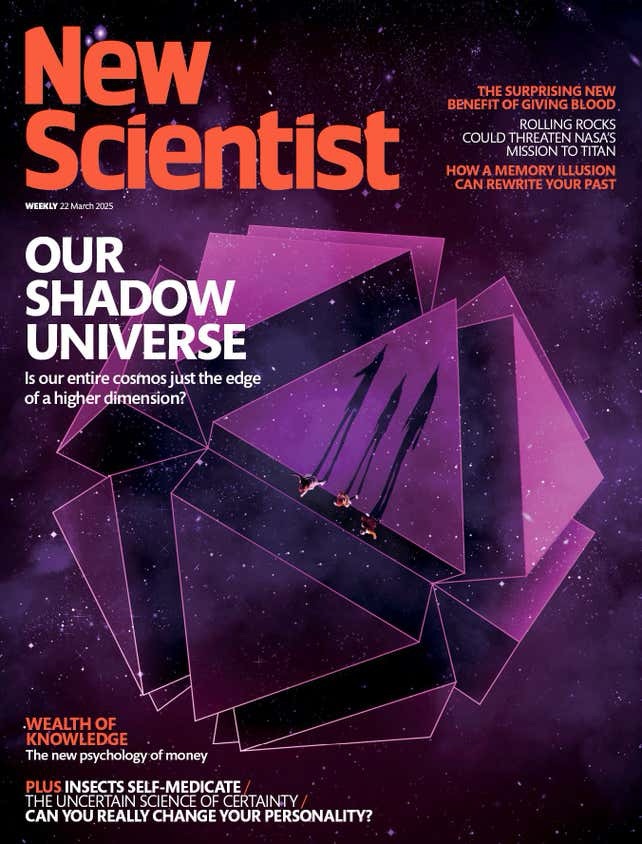
Do we live on the End of the World?
The “End of the World” is a strange object, motivated by quantum gravity, that marks the ending of all space and time. ‘Nothing’ lies beyond. Could our universe be the End of the World? We show that an inhabitant would observe an accelerating expanding spacetime, just like our own universe. Along the way we show that ‘nothing’ (as in ‘no space nor time’) can be thought of as an infinitely curved spacetime. Wild.
We made the cover of New Scientist!! Read the story here.
Tony also wrote a New Scientist piece on nothingness.
Also check out the column I wrote for Weekendavisen. (In Danish)
Horndeski speed tests with scalar-photon couplings
There are mind-boggling tight constraints on the speed of light (


Starobinsky inflation in the swampland
Starobinsky inflation has historically been one of our most successful (and simplest!) models to explain the accelerated expansion of our infant universe. We argue that it is at odds with some fundamental expectations for what makes a “good theory” that is consistent with quantum gravity. This places it in the so-called swampland of incompatible theories.
 Benjamin Muntz